Monday, October 6, 2008

Cambodia – A vibrant culture, charming people, jaw-dropping sights (part 4)

Angkor Archaeological Complex

The Splendours of Angkor Thom, the Bayons & Ta Prohm Temples

Angkor Thom was built by Cambodia's greatest builder, Jayavarman VII. This 12 sq km city is enclosed by a 8m high wall and encircled by a 100m moat said to have been inhabited by fierce crocodiles. There are five 20m high gates in the wall in each of the North, West and South walls and 2 in the East Wall. Access is via causeways over the moat that are flanked by the statues of 54 Gods on the left and 54 four devils on the right, all seemingly engaged in a game of tug of war.

The moats played a vital role of defense in the ancient time and the walls functioned as defense. The earthen embankments inside serve two functions:
1. they support the walls so that the walls could not be pushed inward
2. they were used for the King’s soldiers to walk on the top to safeguard the city.

There are 5 entrances (gates) to the city, each is decorated with four giant faces in cardinal point which first represent the face of Brahma, one of the three main gods in Hindu religion, second represent the face of Buddha, the face of the king, and also means compassion, sympathy, charity and tolerance that the king had for his people. Angkor Thom was built over an existing city called Yasodharapura of the 10th century.

The Bayon is the major attraction of Angkor Thom. Lying at the centre of Angkor Thom, they were built in the latter part of the 12th century by Jayavarman VII. Bayon is one of the most widely recognised temples in Siem Reap because of the giant stone faces that adorn the towers of Bayon. When you first enter the temple, it seems to be a shapeless mass of grey and brown stone but as you approach the temple, the image of hundreds of carved stone faces become apparent. In addition to the carved stone towers, the highlight of Bayon is the bas reliefs which adorn the walls of galleries around the temple. Each wall has diverse themes depicting scenes of the military procession, sea battle, childbirth, cockfighting, palace and daily life of the locals. Built about 100 years after Angkor Wat, Bayon is now the second most popular site after Angkor Wat and no visit is complete without a trip to see this amazing and unique temple.


Top left: North Gate
Top Middle: East Gate
Top Right: West Gate
Bottom Left: South Gate
Botton Right: Victory Gate

Angkor Thom & the Bayons
The series of colossal human faces curved in stone at the Southern Gate.


On the top terrace of the Bayon you come face-to-face with myriad giant heads topped with lotus crowns. The brownish stone is splotched with moss, lichen, and green fern growth. The giant stone faces of Bayon have become one of the most recognizable images connected to classic Khmer art and architecture. There are 37 standing towers, most but not all sporting four carved faces oriented toward the cardinal points. The best of Bayon are the bas-reliefs on the exterior walls of the lower level and on the upper level where the stone faces reside. The bas-reliefs on the southern wall contain real-life scenes from the historical sea battle between the Khmer and the Cham.


Take your time ...

to view and appreciate ...

each and every of these 200 faces with mysterious looks...

and be fascinated by their calmness, their smile, their greatness...


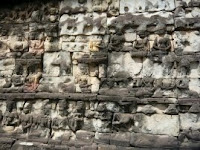
These are the bas relief on the south wall of Bayon...


Ta Prohm Temples


The 800-year-old Ta Prohm shrine, better known as temple of trees, was one of the first temples built by the great builder King Jayavarman VII around 1186. It is best known as the temple where trees have been left intertwined with the stonework, much as it was uncovered from the jungle. You may think this temple is in a state of disrepair but there is a strange beauty in the marvelous strangler fig trees which provide a stunning display of the embrace between nature and the human handiwork.

This is one of the most popular temples after Angkor Wat and the Bayon because of the beautiful combinations of wood and stone. The temple deliberately left overgrown with trees to preserve the sense of how the ancient complex of ruins was found in the 1800s. Entered the temple through the east gate and see a long white sandy path between the outer gate and the inner sanctuary, you may recognize a few scenes from Angelina Jolie's Tomb Raider.

While the temple is very popular, most visitors follow a central route and the sides of the complex are surprisingly quiet. Take note that large sections of the temple are unstable rubble and have been cordoned off, as they are in real danger of collapse. Restoration work funded by the government of India began in 2006.


right: this doorway was featured in the Lara Croft Tomb Raiders movie with Angelina Jolie.


Within the ancient city of Angkor Thom holds a number of other sites of interest:

>> The Elephant Terrace


>> The Terrace of the Leper King

Left: Statue of the Leper King
Right: Terrace of the Leper King

>> The Phimeanakas
Located inside the ancient Royal Palace compound, the Phimeanakas served as the king’s temple. The lack of surviving carvings leaves it artistically uninteresting, but it is the tallest scalable temple in Angkor Thom, providing a nice view from the top. The western staircase (right picture), located at the back is the most easily ascended.


>> Phnom Bakheng
It is the first temple-mountain constructed in Angkor, with a commanding hilltop location. It is a popular spot to watch sunset. However, before you enjoy the beautiful sunset, you need to hike at least half an hour to the top. Be careful, the final climb to the top of the temple is steep and dangerous. Even if you pay $15 for an elephant to carry you to the hilltop, you still have to climb the temple stairs on your own.


A piece of advice: Ascend early to get a good spot to view the sunset. Descend before the sky gets dark. It's good to bring a touchlight with you.

Sunday, October 5, 2008

Cambodia – A vibrant culture, charming people, jaw-dropping sights (part 3)

The charming Cambodians...

The future leaders of Cambodians.


Be happy is their drive...

Saturday, October 4, 2008

Cambodia – A vibrant culture, charming people, jaw-dropping sights (part 2)

Cambodia is a place that will capture your heart, if you let it. I'm glad I made this trip because there are many things that make me feel grateful for the life I live every day.

Life in Cambodia...
Women are not sitting at home, they also eking out a living based on what they can do.

top left: selling grilled bananas
top right: selling steamed groundnuts


top left: selling pancake.
top right: selling fruits and dried products.

Insects become delicacies...
top left: deep fried locusts and crickets!
top right: deep fried frogs, pigeons and spiders!

top left: dried fishes
top right: these are not orange juices, they are fuel, come in all sizes -S, M & L.

On the ROAD...
Usually, traffic moves in both directions in both lanes, just weaving in and out and around to avoid head-on collisions. Safety is not much of a consideration. Luckily the slow speeds of traffic in the city--partly due to the congestion, partly to the poor condition of the roads--keeps more people from being killed although quite enough are injured daily.

Bicycles, cyclos (3-wheeled double-seat bicycles) and motorbikes are the normal vehicles in traffic.

top left: Here a family of 4, Dad, mum and 2 kids, fits very comfortably on a typical motorbike.

top left: large cyclos
top right: Sammel Taxi

Their HOMES...
The Fishing industry is one of the most important in Cambodia. Over 2 million people live on or around Tonle Sap, the largest freshwater lake in South East Asia.


More than 85% of Cambodia's people are farmers, and 85% of the farmers still use cattles for plowing.

Friday, October 3, 2008

Cambodia – A vibrant culture, charming people, jaw-dropping sights (part 1)

A Little Background

Cambodia has had a pretty bad run of luck for the last half-millennium or so. Ever since the fall of Angkor in 1431, the once mighty Khmer Empire has been plundered by all its neighbors, plus colonial France as well. After a false dawn of independence in 1953, Cambodia promptly plunged back into the horrors of civil war in 1970 to suffer the Khmer Rouge's incredibly brutal reign of terror, and only after UN-sponsored elections in 1993 did the country begin to totter back onto its feet.

Much of the population still subsists on less than US$1 a day, the provision of even basic services remains spotty and political intrigue remains as complex and opaque as ever; but the security situation has improved immeasurably, and increasing numbers of visitors are rediscovering Cambodia's temples and beaches. Siem Reap, the gateway to Angkor, now sports luxury hotels, chic nightspots, ATMs, and an airport fielding flights from all over the region.

It is important to remember that Cambodian history did not begin with the Khmer Rouge. Pol Pot's incredibly harsh regime has garnered most attention, but the Cambodians enjoy a long and often triumphant history. Anybody who witnesses the magnificence of the temples at Angkor will be able to see that the Khmer Empire was once wealthy, and a major force in the region.

Where is Cambodia?
Location: Southeast Asia, between Thailand, Vietnam and Laos
Full Country Name: Kingdom of Cambodia
Capital: Phnom Penh
Area: 181040
Population: 14,000,000
People: 94% ethnic Khmers, 4% Chinese, 1% Vietnamese
Language: Khmer, English, French
Religion: 95% Buddhist, 5% others
Currency: Riel (CR)
Time Zone: GMT +7
Head of State: King Norodom Sihamoni
Head of Government: Prime Minister Hun Sen
Major Industries: Timber, rubber, rice milling, textiles, fishing

Who were the Khmer Rouge?
Khmer Rouge derives from the French word, Khmer + Rouge = Red Khmer.


The Khmer Rouge, organized by Pol Pot in the Cambodian jungle in the 1960s, advocated a radical Communist revolution that would wipe out Western influences in Cambodia and set up a solely agrarian society. In 1970, aided by North Vietnamese and Viet Cong troops, Khmer Rouge guerrillas began a large-scale insurgency against Cambodian government forces, soon gaining control of nearly a third of the country.

By 1973, secret U.S. bombings of Cambodian territory controlled by the Vietnamese Communists forced the Vietnamese out of the country, creating a power vacuum that was soon filled by Pol Pot's rapidly growing Khmer Rouge movement. In April 1975, the Khmer Rouge captured Phnom Penh, the Cambodian capital, overthrew the pro-U.S. regime, and established a new government, the Kampuchean People's Republic.

As the new ruler of Cambodia, Pol Pot set about transforming the country into his vision of an agrarian utopia. The cities were evacuated, factories and schools were closed, and currency and private property was abolished. Anyone believed to be an intellectual, such as someone who spoke a foreign language, was immediately killed. Skilled workers were also killed, in addition to anyone caught in possession of eyeglasses, a wristwatch, or any other modern technology. In forced marches punctuated with atrocities from the Khmer Rouge, the millions who failed to escape Cambodia were herded onto rural collective farms.

Between 1975 and 1978, an estimated two million Cambodians died by execution, forced labor, and famine. In 1978, Vietnamese troops invaded Cambodia, capturing Phnom Penh in early 1979. A moderate Communist government was established, and Pol Pot and the Khmer Rouge retreated back into the jungle.

In 1985, Pol Pot officially retired but remained the effective head of the Khmer Rouge, which continued its guerrilla actions against the government in Phnom Penh. In 1997, however, he was put on trial by the organization after an internal power struggle ousted him from his leadership position. Sentenced to life imprisonment by a "people's tribunal," which critics derided as a show trial, Pol Pot later declared in an interview, "My conscience is clear." Much of the international community hoped that his captors would extradite him to stand trial for his crimes against humanity, but he died of apparently natural causes while under house arrest in 1998.